Travel to Ireland
Day 4 Derry, Marble arch caves (268 Km.)
(in 268 Km.) Derry: The old part of the city of Derry, officially Londonderry, extends on the west bank of the Foyle River, but the city currently occupies both sides of the river course, these being connected by three bridges, the third of which was inaugurated in June 2011 under the name of "Peace Bridge". It is the second largest city in Northern Ireland. During the reign of James II of England, who tried to restore the rights of Catholics, the Irish tried to drive out Protestant Scottish farmers who had settled in foreign lands, but they were locked in the city of Derry (for Pro-Irish Catholics) or Londonderry (for Probritan Protestants). When James II was dismissed by William of Orange, Irish Catholics were severely punished.

Londonderry - Bogside
Between August 12th and 14th, 1969, the Battle of the Bogside took place, disturbances that occurred in the Bogside neighborhood of Derry, between residents of the Catholic district and the police (the Royal Ulster Constabulary, RUC). That resulted in a series of social disorders that culminated in the creation of an autonomous self-proclaimed area (the "Free Derry"), which remained under the dominion of the Irish nationalists until 1972. On January 30, 1972, in the so-called Bloody Sunday 13 men and boys, not armed, died in the city because of the shooting of the British paratrooper force after a demonstration in favor of Civil Rights for Catholics in Northern Ireland in the Bogside neighborhood. It is precisely in this neighborhood where we begin the visit of the city, contemplating its murals.

Londonderry - St Columb´s Cathedral
From the corner of Free Derry Corner we go up to the city walls, built in 1613. There is a round road over the walls that offers beautiful views. We enter the walled city through the Bishop's Gate and then we arrive at the St Columb's Cathedral, Gothic plant, finished in 1633. In the center of the walled city we find The diamond square, in the center of which we find a memorial dedicated to the dead of the two world wars. We continue along the Shipquay street and on your left we find the craft village, a set of alleys where we find craft shops and restaurants.

Londonderry - Guildhall
After crossing the Squipquay gate, next to which is the Tower museum, a museum about local history, we leave the walled city and arrive at the town hall square. The Guildhall is a building in which the elected members of Derry and Strabane District Council meet. It was built in 1890. The building was badly damaged by two bombs in 1972, but was restored and reopened in 1977. In the interior stands out the huge pipe organ located in the main hall and the stained-glass windows. Next to the Guidhall we find a park in the center of which we find a monument of the Flame of Peace and on the Foyle River, the Bridge of Peace, 235 meters (771 feet), opened on June 25, 2011 for pedestrians and bicycles with the aim of improving relations between unionists and nationalists.
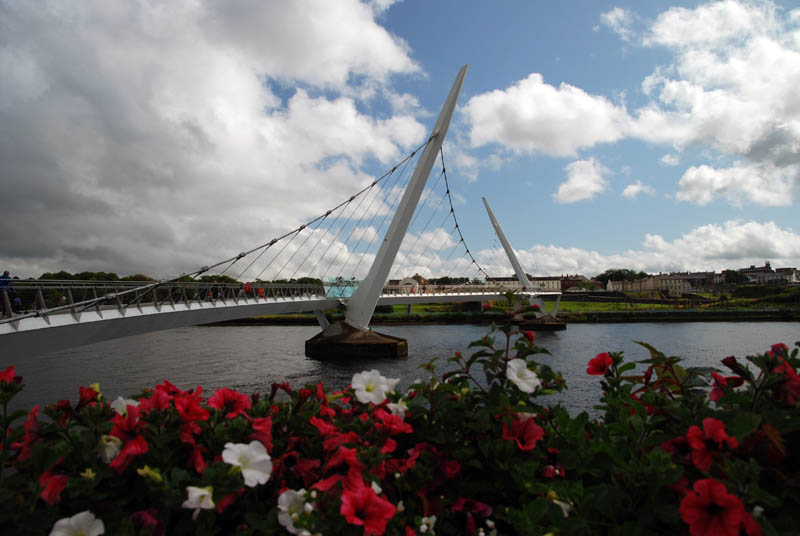
Londonderry - The Peace Bridge
(in 106 Km.) Marble Arch: The Marble Arch Caves are a series of natural limestone caves located near the village of Florencecourt in County Fermanagh, Northern Ireland. The caves are named after the nearby Marble Arch, a natural limestone arch at the upstream end of Cladagh Glen under which the Cladagh River flows. The caves are formed from three rivers draining off the northern slopes of Cuilcagh mountain. At 11.5 kilometres (7.1 mi) the Marble Arch Caves form the longest known cave system in Northern Ireland. Before going to the caves we call by phone to book since sometimes, if it has rained a lot, the visit is closed. We, because of the amount of water inside the cave, could only do half of the visit, missing the part of the boat trip.

Marble arch caves
(in 47 Km.) Glencar waterfall: After 3 days in Northern Ireland, we enter the Republic of Ireland. Our first visit is to the Glencar waterfall. We park along the north bank of the Glencar Lough, from where a beautiful path that advances for just 200 meters along the river takes us to the base of the 15-meter high waterfall. It is not one of the largest waterfalls in Ireland, but one of the most beautiful.

Glencar waterfall
(in 109 Km.) Ballintober: In addition to the different tourist places we visited during our trip to Ireland, we highlight another that does not appear on any list. One of our best experiences in Ireland was staying at the Bed & Breakfast "Tranquil Escapes B&B" in Ballintober. In addition to a nice house and stunning breakfasts, we enjoy the kindness of Maura and Martin, their hosts. To give an example, as they liked a lot, my daughters were taught one morning to prepare their tasty pancakes. Staying here helped us to enjoy our trip through Ireland even more.